



Amazon Seller Assistant is no longer limited to answering seller questions or directing users to relevant resources. With its agentic AI upgrade, it can analyze account-wide Seller Central data, reason through operational issues, recommend next steps, and execute approved actions on a seller’s behalf.
This changes how sellers can manage inventory, account health, compliance, listings, and advertising workflows. Instead of relying only on periodic manual reviews, sellers can use AI for continuous monitoring, faster issue identification, and decision support across the account.
For e-commerce sellers, this raises an important question: can AI handle routine account operations independently, or will human expertise remain essential for making high-impact marketplace decisions?
What Changed in Amazon Seller Central: From Generative Answers to Agentic Execution
Amazon released thE agentic upgrade to Seller Assistant in September 2025. Three architectural changes separate it from the generative version that preceded it.
- Account-Wide Data Access: The assistant reads across Seller Central, including catalog data, sales velocity, inventory position, and account health metrics. It evaluates a question against all four together, not against a single report.
- Authorized Action: The system reasons, plans, and takes action on the seller’s behalf once the seller grants permission. It moves from recommending an action to completing the task behind it.
- Foundation Model Infrastructure: Seller Assistant runs on Amazon Bedrock and draws on Amazon Nova and Anthropic Claude, combined with Amazon’s accumulated seller operations knowledge.
How Agentic AI Is Transforming Amazon Account Management
1. FBA Inventory Planning and Demand Forecasting
- Continuous Inventory Monitoring: Seller Assistant tracks FBA inventory levels and flags slow-moving products before they accrue long-term storage costs. It classifies each SKU into retain, mark down, or remove, rather than returning an undifferentiated excess-stock report.
- Demand-Based Shipment Planning: The Amazon Seller Assistant analyzes historical sales against current demand patterns and prepares inbound shipment recommendations. At this level, Amazon inventory optimization includes allocation between FBA fulfillment centers and Amazon Warehousing and Distribution, balancing delivery speed against storage cost.
- Peak Season Inbound Planning: When a seller asks about timing a shipment ahead of rising seasonal demand, the Amazon Seller Assistant reviews the full catalog and compares historical data with current trends before returning an allocation plan.
2. Account Health Monitoring and Issue Resolution
Through proactive monitoring, Amazon’s Agentic AI changes account health management from primarily reactive remediation to earlier risk detection. Instead of waiting for a performance notification, sellers can identify emerging policy, listing, or customer service issues and review corrective actions sooner.
- Proactive Risk Detection: The Amazon Seller Assistant scans account status behind the scenes and surfaces listings that may violate current product safety regulations, along with customer service metrics approaching warning thresholds.
- Root-Cause Analysis: A seller requesting an account health summary receives the issues needing immediate attention, the trigger behind each one, and recommended corrective actions.
- Approved Remediation: The Amazon Seller Assistant can recommend corrective actions for identified account health issues, explain the implications of each option, and proceed once the seller approves a resolution path. For example, if a product description unintentionally implies a pesticide-related function and could place the ASIN under regulated-product requirements, the Seller Assistant can explain the compliance concern and guide the seller through the appropriate corrective action.
3. Compliance Navigation in Regulated Categories
Entering regulated categories or expanding into new markets often requires sellers to identify applicable safety standards, gather the right documentation, and resolve compliance gaps before a listing can proceed. Amazon Seller Assistant brings more of this compliance work into the listing workflow by reviewing documentation and providing product-specific guidance.
- Automated Document Analysis: When a seller lists a regulated product, the Amazon Seller Assistant reviews submitted documentation and identifies gaps, such as missing UL certification for an electronics product.
- Regulatory Requirements: It then explains which specific standards apply to that product and why, and walks the seller through completing the documentation step by step.
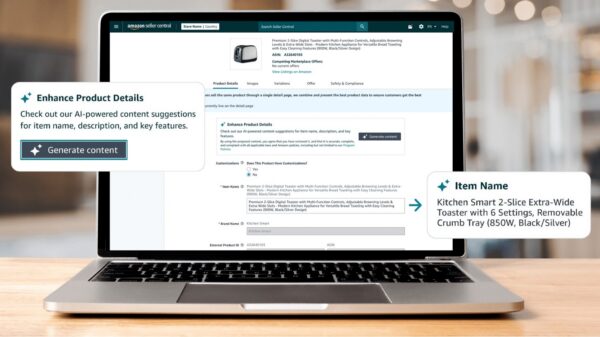
4. Catalog and Product Detail Page Enhancement
Amazon Seller Assistant supports ongoing catalog enrichment by helping sellers create listing content and identify updates as product and shopper signals change. Rather than treating PDP optimization as a periodic exercise, sellers can review and refine recommended content within the listing workflow before publication.
- Listing Content Generation: Amazon’s generative listing tools draft titles, bullet points, descriptions, and attribute values from seller-supplied product information or images.
- Product Detail Optimization: Enhance My Listing analyzes shopping and engagement signals on existing ASINs, then recommends updates to titles, descriptions, attributes, and missing details.

5. Amazon Ads Creative Generation
Seller Assistant supports Amazon advertising workflows by helping sellers develop campaign concepts and creative assets more efficiently. Creative Studio uses conversational inputs and Amazon shopping signals to generate advertising ideas and assets tailored to products and campaign objectives.
- Conversational Ad Creative Generation: Sellers can use natural-language prompts to generate professional-quality advertising assets, reducing the time required to move from a campaign idea to usable creative.
- AI-Assisted Campaign Concepts: Creative Studio analyzes seller products alongside Amazon shopping signals to develop relevant ad concepts and explain the rationale behind its recommendations.
For example, Amazon reported that a smart bird feeder seller used Creative Studio to produce a Father’s Day Sponsored Video ad. Compared with the seller’s other active Sponsored Video campaigns, it achieved a 338% higher click-through rate and 89% new-to-brand orders.
What the Canvas Experience Adds to Amazon Account Management
Amazon extended the same agentic architecture to a canvas experience in March 2026 for sellers. The canvas converts a natural-language question into an interactive workspace rather than a text reply.

This interactive workspace can support sellers across several planning and optimization scenarios:
- Replenishment as a Decision Simulation: A restock query returns multiple paths: replenish now, delay to observe demand, or discount excess units. Each path carries a projected effect on revenue, cash flow, stockout risk, storage fees, and competitive positioning.
- Conversational Scenario Testing: Sellers adjust the inputs in plain language, with questions such as a 10% demand decline or a discount in place of a replenishment order. The projections update in real time.
- Campaign Diagnosis and Forward Planning: A promotions query returns an analysis of spend, impressions, conversions, and product-level sales lift, followed by strategies with stated rationale and projected outcomes. Sellers can constrain the plan by budget or by inventory position, and the canvas revises it.
- Launch Prioritization: For a product launch question, the canvas combines historical sales trends, customer insights, category demand signals, and competitive intensity into a prioritized strategy with tradeoffs stated in investment, risk, and time to profitability.
If AI Can Manage Accounts, What Role Do Amazon Specialists Play?
Agentic AI in Amazon can automate high-volume monitoring, analysis, recommendations, and approved actions across Amazon account management. However, automation often lacks the full business context needed to judge product claims, commercial trade-offs, regulatory nuances, or exceptions in operational data. Human oversight fills this gap by validating AI outputs, applying account-specific judgment, and retaining final authority over actions with financial, compliance, or brand impact.
The table below shows which tasks can be automated and where specialist intervention remains necessary across key account management functions.
| Operational Area | What AI Handles | Where the Specialist Oversight is Needed |
| FBA Inventory & Forecasting | Inventory monitoring, slow-moving SKU identification, demand analysis, and replenishment or allocation recommendations | Forecast validation against lead times, inbound inventory, cash-flow priorities, and broader supply-chain constraints |
| Account Health | Continuous risk monitoring, issue detection, root-cause analysis, and recommended resolution paths | Review of corrective actions, supporting evidence, documentation, appeals, and higher-risk account decisions |
| Compliance | Document review, identification of missing requirements, and product-specific compliance guidance | Verification of product claims, certifications, regulatory documentation, and final compliance decisions |
| Catalog & PDP | Listing content generation, missing-attribute identification, and recommendations for titles, descriptions, and product details | Product accuracy, claims verification, brand consistency, merchandising judgment, and approval before publication |
| Amazon Advertisement | Ad concept development and creative generation using product information, prompts, and Amazon shopping signals | Campaign objectives, brand messaging, creative suitability, and final asset selection |
How Sellers Should Operationalize AI in Amazon Account Management
The business value of agentic AI in Amazon operations comes from faster decision-making, lower manual effort, improved account responsiveness, and greater scalability across ASINs. These gains depend on how well sellers combine automation with specialist oversight across catalog, inventory, compliance, advertising, and account health workflows.
The right approach: Use AI to increase operational capacity and accelerate routine decision-making, while keeping experienced specialists responsible for validating higher-impact actions, interpreting account context, and aligning execution with margin, brand, and growth objectives.
- Define Automation Boundaries: Specify which Seller Central activities AI can monitor, recommend, or execute, and which require specialist approval. Apply stricter review thresholds to actions affecting pricing, FBA inventory, compliance, promotions, or account health.
- Standardize Review and Escalation Rules: Establish clear approval criteria for AI-generated recommendations and define when exceptions should move to a specialist. This prevents inconsistent decisions across ASINs, categories, and marketplace functions.
- Maintain Cross-Functional Account Oversight: Review how AI-driven actions interact across listings, inventory, advertising, compliance, and account health. A recommendation that improves one metric may create downstream effects on margin, stock availability, or listing eligibility.
- Scale Expertise with the Right Operating Model: Where internal teams lack the capacity to review growing catalogs and account activity, use Amazon account management services to add marketplace expertise, execution support, and scalable operational coverage.
The sellers that gain the most from agentic AI will not be those that automate the most tasks. They will be those that clearly define where automation can operate independently, where specialist review is required, and how both work together to improve account performance.
Hazel James is an e-commerce consultant at SAMM Data — a leading e-commerce growth agency offering product data management, e-commerce marketing, marketplace management, and branding & creative solutions. She works closely with 45+ brands to optimize their e-commerce operations and uncover new growth opportunities.
Hazel excels at analyzing market trends, spotting emerging technologies, and implementing best practices, enabling businesses to maintain a competitive edge. With her expertise, she helps brands make data-driven decisions and streamline their operations, ensuring long-term growth and operational efficiency.