


For a small retailer or e-commerce business owner, finding products to sell may be the easy part of running the business. Finding the right supplier can require hours of research, requests for quotes, price comparisons, negotiations over minimum orders and production schedules, sample orders, and countless decisions about cost, quality, and reliability.
Large companies can assign teams to that work. Small business owners often do it themselves.
Alibaba.com thinks AI agents can begin to change that equation.
At its recent CoCreate conference in Los Angeles, Alibaba.com introduced expanded capabilities for Accio, its AI agent for commerce. Accio can now handle much of the sourcing process on behalf of a business owner — identifying and comparing suppliers, issuing requests for quotes, negotiating terms, and helping initiate sample orders — while leaving consequential financial decisions in the owner’s hands.
And Alibaba.com sees that as only the beginning. The company believes B2B commerce could eventually evolve to A2A — agent-to-agent commerce — in which AI agents acting on behalf of buyers and sellers interact directly with one another.
The Sourcing Team a Small Business Couldn’t Afford
One of the biggest differences between small businesses and their larger competitors has always been capacity.
A large retailer may have employees devoted to procurement, supply-chain management, market research, marketing, e-commerce, and customer service. At a small company, several — or all — of those jobs may belong to the owner.
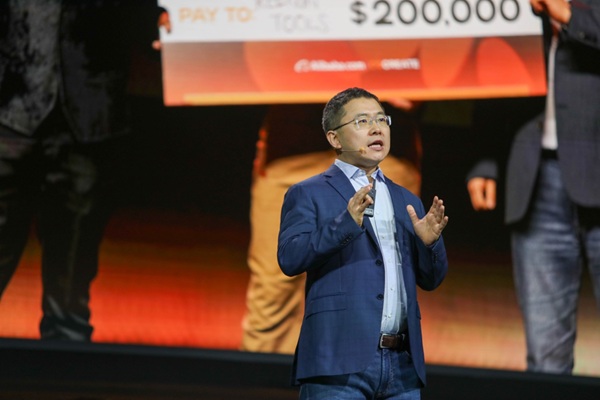
Alibaba.com President Kuo Zhang describes Accio as an “agentic sourcing team.”
Instead of simply responding to a search and producing a list of potential suppliers, Accio can carry out multiple steps in the sourcing process. It can contact multiple suppliers simultaneously, issue requests for quotes, compare responses, and negotiate based on requirements established by the business owner.
For example, business owners can give Accio parameters including a target price, lead time, minimum order quantity (MOQ), and product specifications. Accio can then conduct multiple rounds of negotiations involving FOB and CIF pricing, sample costs, production schedules, and minimum order quantities.
It can also help move the process beyond negotiation. Once potential suppliers have been identified, Accio can help initiate sample orders so owners can evaluate products before committing to a larger production order.
For entrepreneurs accustomed to doing that work themselves, the potential time savings can be substantial.
“Accio took 90% of finding products for multiple international vendors off the table,” says John Lawson, CEO of Colder Ice Media. “It’s amazing.”
The Owner Still Holds the Keys
Giving an AI agent the ability to negotiate with suppliers raises an obvious question: How much authority does the agent have?
With Accio, the business owner establishes the commercial requirements the agent works within. Accio can handle parts of the process autonomously and escalate important decisions when necessary.
But high-stakes actions involving money require explicit approval from the owner. Accio doesn’t independently commit a business to a production order or take control of fulfillment without authorization.
That distinction is important to understanding agentic AI.
The entrepreneur isn’t necessarily handing over the business decision. Instead, the owner’s role begins to shift from performing every step of the work to setting the objective, establishing parameters, evaluating important decisions, and authorizing consequential actions.
The agent does more of the legwork. The owner retains control.
Why Better Sourcing Can Mean Better Margins
The value of automating sourcing isn’t simply saving a few hours at the computer.
Supplier decisions can affect nearly every part of a product business: margins, inventory availability, product quality, shipping costs, delivery schedules, and ultimately the promises a business can make to its customers.
For a small business, having more sourcing options can also provide something larger companies often have more of: optionality.
If one supplier can’t meet a target price, production schedule, minimum order requirement, or other important condition, being able to efficiently identify and compare alternatives can make the business less dependent on any single source.
AI doesn’t eliminate the owner’s judgment about which trade-offs are worth making. But it could give the owner more information and more viable choices without requiring the time or staff that extensive sourcing traditionally demands.
Zhang says accessibility is central to Alibaba.com’s approach.
“For small businesses, unaffordable AI is useless,” he says. “Our goal is not simply to make AI more powerful. It is to make commerce AI practical and affordable for even a one-person company.”
When B2B Becomes A2A
What Accio does today is not yet the fully autonomous agent-to-agent marketplace Alibaba.com envisions.
Currently, Accio can automate sourcing and supplier interactions while business owners remain responsible for key decisions and transactions.
But Alibaba.com sees a longer-term evolution in which AI agents acting for different businesses interact directly with one another.
Imagine a small retailer’s purchasing agent communicating with a supplier’s selling agent. The agents could potentially exchange product requirements, negotiate acceptable terms, coordinate an order, and handle other parts of the transaction within parameters established by their respective businesses.
That’s A2A: agent-to-agent commerce.
It doesn’t necessarily mean removing people from commerce. Instead, it could change where people participate.
Rather than spending hours finding suppliers, requesting quotes, comparing terms, and negotiating back and forth, an entrepreneur could increasingly determine what the business needs, what constitutes an acceptable deal, how much authority the agent has, and when a human needs to approve the decision.
Fully autonomous buyer-agent-to-seller-agent commerce remains a longer-term direction, according to Alibaba.com. Accio represents a step toward that vision, not its completion.
What Happens When Your Customer Is an AI Agent?
For small business owners, there’s another side to A2A that’s easy to overlook.
Much of the discussion about AI agents focuses on how they can help businesses source products. But there’s another side to the transaction: If businesses increasingly delegate sourcing decisions to AI, suppliers may eventually have to think about selling to those agents as well.
Today, a business wants prospective customers to find its website, understand its products, trust its reputation, and choose it over its competitors.
And tomorrow’s prospective “customer” may sometimes be an AI agent evaluating suppliers on behalf of a business.
That raises a new set of questions for companies that sell to other businesses: Can an AI agent find your business? Can it understand what you sell? Can it evaluate your pricing, product specifications, reliability, delivery capabilities, and other information it needs to determine whether you’re a good fit?
And eventually: Will the agent choose you?
For years, B2B companies have built their sales strategies around attracting and persuading human buyers. If Alibaba.com’s vision takes hold, businesses may also have to learn how to sell to the agents working for those buyers.
That’s when B2B really starts becoming A2A.
Rieva Lesonsky is the founder of Small Business Currents, a content company focusing on small businesses and entrepreneurship. You can find her on Twitter @Rieva, Bluesky @Rieva.bsky.social, and LinkedIn. Or email her at Rieva@SmallBusinessCurrents.com.