
Creators have become a powerful force in commerce, helping consumers discover everything from clothing and cosmetics to food and technology. But traditionally, much of the economic value creators generate has gone to the brands whose products they promote.
What happens when creators stop simply marketing other companies’ products and start building their own businesses?
That’s the idea behind MuseSelect, an AI-powered creator commerce platform that made its U.S. debut at Alibaba.com’s CoCreate LA. MuseSelect launched its U.S. Creator Fashion Market with more than 5,000 fall and winter looks from over 100 fashion brands and introduced Muse 1000, a program designed to help 1,000 creators launch fashion labels over the next three years.
I talked with MuseSelect CEO Ricky Xie at CoCreate about how the platform is attempting to move creators from affiliate marketing to entrepreneurship — and how AI may lower some of the traditional barriers to starting a fashion business.
From Selling Products to Owning the Business
The opportunity is significant. U.S. social commerce sales are projected to exceed $100 billion in 2026, according to eMarketer, and 58% of U.S. adults have purchased something because a creator endorsed it.
But creators typically don’t own the brands they’re helping sell.
MuseSelect is trying to create a progression from affiliate to business owner. Creators can begin by selecting products to promote and earning commissions of up to 25%. There’s no minimum follower requirement, and the platform handles fulfillment.
From there, creators can develop their own storefronts and eventually create products and brands of their own.
Xie told me that distinction matters because an affiliate earns a commission determined by someone else’s business. A business owner has far more control — including the ability to choose products, build a brand, and set prices.
“The creator is the business owner,” Xie said.
That may be the most interesting part of the model. Instead of requiring someone to start by designing a collection, finding manufacturers, ordering inventory, building an e-commerce site, producing photography, and then finding customers, MuseSelect is attempting to let creators enter the process incrementally.
They can sell first, learn what their audiences respond to, and then decide whether to build something of their own.
 Testing Demand Before Betting on Inventory
That also changes one of the riskiest parts of launching a product business: figuring out whether anyone actually wants what you’re planning to sell.
Creators can select products and test them with their existing communities. Pre-sales and audience response can then signal demand before production increases.
That feedback can benefit suppliers as well. Rather than producing large quantities based primarily on forecasts, manufacturers potentially get earlier information about what consumers are responding to.
It’s a particularly interesting reversal of the traditional fashion model. Instead of make it, stock it, and hope people buy it, the process can increasingly become show it, measure interest, and then make more of what sells.
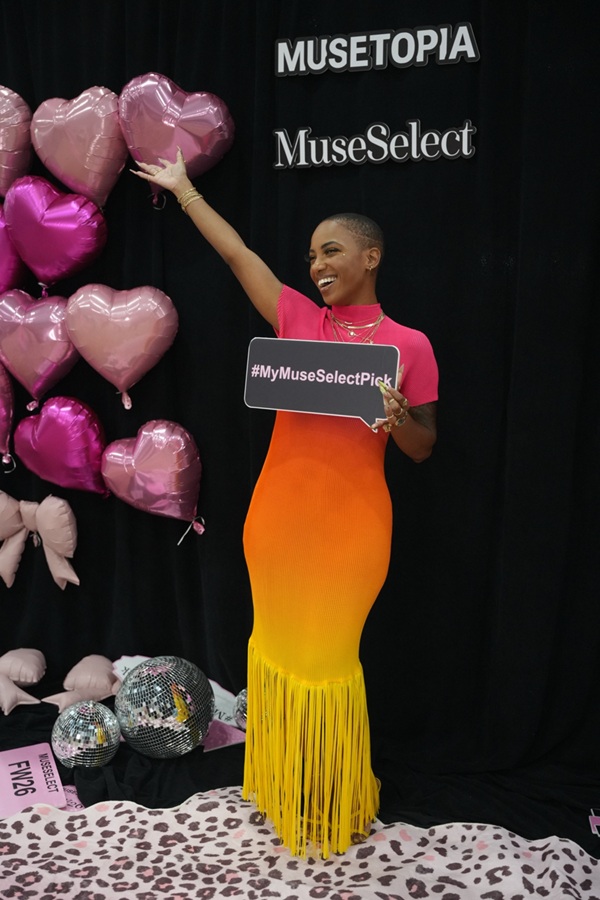
At CoCreate, that connection between creators and products was happening physically. MuseSelect’s Creator Fashion Market occupied about 2,000 square meters of the Los Angeles Convention Center, where creators could browse products, try on clothing, create content, and select merchandise for their storefronts.
Xie told me interest was strong. MuseSelect says about 10,000 creators registered during its first two months, and 10 storefronts in a U.S. pilot program generated nearly $300,000 in sales over three months. One creator generated more than $100,000 in sales.
Those are early results from a very small pilot, but they offer a glimpse of what the company hopes to scale through Muse 1000.
Using AI to Remove the Startup Friction
AI plays a role at several stages of the process, but what interested me most was that Xie wasn’t talking about AI simply as a way to generate prettier marketing images.
He described it as a way to reduce the time, expense, and expertise traditionally required to turn an idea into a business.
One example is content creation.
Traditionally, a creator promoting a fashion product might select a sample, wait for it to be shipped, plan a shoot, photograph or film it, edit the content, and finally publish it. Xie said that process can take weeks.
MuseSelect uses AI to generate on-model product imagery and other content assets, allowing creators to evaluate products and produce marketing content without waiting for every physical sample. Xie described the goal simply: using AI “as a new way to help a creator to do the content.”
AI is also being used on the product side. Through Museland, creators can select garment silhouettes, experiment with patterns and graphics, and turn their ideas into products. Creators who originate designs can earn commissions plus a 3% royalty.
In other words, someone doesn’t necessarily need traditional fashion-design skills to begin experimenting with a product idea.
From Creator to Business Owner
The third use of AI may be the most relevant to entrepreneurs.
Xie showed me how AI agents can help create the basic infrastructure for a creator’s storefront — including its name, imagery, product selection, pricing, and promotional campaigns.
Tasks that previously required photographers, designers, e-commerce expertise, spreadsheets, and considerable time can increasingly be assisted by AI.
And that matters because being good at creating content doesn’t automatically make someone good at calculating margins, setting prices, sourcing products, managing inventory, or building an e-commerce operation.
As Xie put it, creators may be fashionable but “have not always enjoyed calculating margins.”
I understood exactly what he meant. I’m a writer. Don’t ask me to calculate anything, either.
But that gets to the larger point.
AI’s most consequential impact on entrepreneurship may not be its ability to perform one spectacular task. It may be that it can remove dozens of small barriers that previously kept someone from turning an idea into a business.
The Next Step in the Creator Economy?
MuseSelect is still new, and whether creators who are successful at influencing consumers can build sustainable brands of their own remains to be seen.
But the premise reflects a larger shift in the creator economy.
The first generation of social commerce largely allowed creators to monetize attention. They built audiences, promoted products, and earned sponsorship fees or affiliate commissions.
The next stage may allow more of them to monetize ownership.
Creators already know their audiences. They can see what generates comments, clicks, shares, and purchases. Platforms such as MuseSelect are betting that if creators are also given access to suppliers, product-development tools, fulfillment, storefronts, and AI-powered business infrastructure, some will make the leap from promoting someone else’s brand to building their own.
And that could create an entirely new pipeline of entrepreneurs.
Rieva Lesonsky is the founder of Small Business Currents, a content company focusing on small businesses and entrepreneurship. You can find her on Twitter @Rieva, Bluesky @Rieva.bsky.social, and LinkedIn. Or email her at Rieva@SmallBusinessCurrents.com.
Photo courtesy MuseSelect
