
The February federal jobs report was released on Friday, March 5. The New York Times reported, “Job growth fizzled in February, a sign of unexpected weakness in the labor market.” Economist and Professor of Economics at the University of Michigan, Justin Wolfers, said, “The economic story just changed dramatically…Recession questions are back on the menu.”
According to the U.S. Labor Department’s jobs report, the nation’s payrolls fell by 92,000 in February, and the unemployment rate rose to 4.4%. January’s reported job growth was revised down by 4,000 jobs. December’s job report was also revised down by 17,000 jobs. The Times reports that “The number of job openings in December, the most recent month for which data is available, fell to its lowest level since September 2020.
What does this mean for the future of the economy? I contacted three economic experts to get their insight.
Ben Johnston, COO, Kapitus
“The February jobs report is a troubling indicator of where the economy is headed. Small businesses are watching their inventories and operating expenses closely as war in the Middle East drives oil prices higher and disrupts supply chains from Asia to Europe.
“This jobs report reflects data compiled before the most recent hostilities began, so it is likely unemployment will continue to rise in the coming months as the higher cost of energy takes its toll on the economy. That being said, a tough winter in the eastern part of the U.S. likely held down small-business payrolls since small businesses typically suffer a dip in revenue during the coldest months of the year.
“The numbers also reflect approximately 30,000 striking healthcare workers, continued reductions in federal government staffing, and a seasonal downturn in the construction industry. However, given the war, ongoing tariff uncertainty, and growth in the adoption of AI across the economy, it is likely that payroll numbers will continue to decline in the coming months.”
Andrew Flowers, Chief Economist, Appcast
“The headline number is bad, and after you dig into the details, it isn’t much better. The shocking decline in employment in February by 92,000 was surely affected by a healthcare strike and government job cuts as well. But looking at private employment excluding healthcare—removing the two largest distortions in the data—still shows a decline of 58,000 [jobs].
“So, it’s not just a healthcare strike effect. When the labor market growth depends on a single industry, we will inevitably end up with large swings like [this one].”
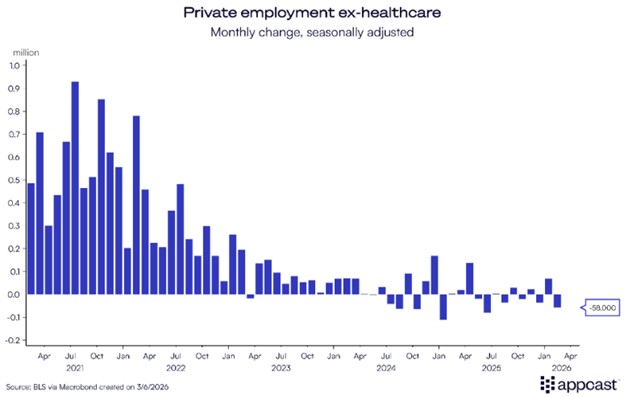 Appcast adds further analysis, saying, “Indeed, there was weakness across the board, with declines in construction, leisure and hospitality, manufacturing, and professional services, among others. Really, only financial activities (+10k) and meager gains in retail (+2k) were notable positives.
“Moreover, there’s other bad news on the household side of the jobs report. With the latest population estimate updates (done annually), the baseline labor force participation and employment-to-population ratios were revised lower. The labor force is now noticeably older, in part due to lower immigration, and as a consequence, participation notches lower.”
Alexandra Rosen, Economist and head of GoDaddy’s Small Business Research Lab
“[Friday’s] softer-than-expected jobs report is insightful, but also does not capture the full picture of the economy. GoDaddy’s data, drawn from more than 20 million small businesses, most with fewer than 10 employees and over half self-employed and missing from payroll jobs data, shows year-over-year increases in digital entrepreneurship nationally across 49 of 50 states through the end of 2025.
“Historically, when ‘Small Street’ activity rises, it has been correlated with stronger payroll job growth and falling unemployment in several quarters ahead, suggesting underlying momentum that may not yet be reflected in today’s official statistics.”
Rieva Lesonsky is the founder of Small Business Currents, a content company focusing on small businesses and entrepreneurship. You can find her on Twitter @Rieva, Bluesky @Rieva.bsky.social, and LinkedIn. Or email her at Rieva@SmallBusinessCurrents.com.
