
Despite economic uncertainty, women launched 44% of all new U.S. businesses last year, down from 2024’s high of 49%, per new data from Gusto. But the biggest story isn’t the overall number. It’s about who is starting those businesses.
This decline was not experienced by all women business owners—it was driven by a pullback in the Goods-Producing sector (manufacturing, construction, wholesale trade).
On the other hand, women-owned businesses in the Personal Services and Community Services sectors saw sustained growth.
Leading the Way
But the youngest adult generation of women led the way in closing the gender gap. Among all Generation Z startups, women launched 47% of those new businesses, compared to 38% in 2024. And more women than men started new businesses among Black (69%) and AAPI (51%) founders.
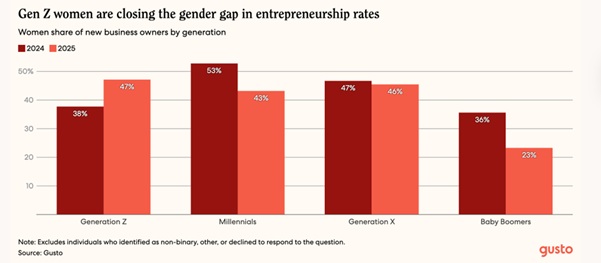 Not all generations of women were in growth mode. Baby boomer women saw the steepest decline, falling from 36% to 23% among their generation. And somewhat surprisingly, millennial women also started a smaller share of new businesses. Gusto economists suggest, “This shift may be related to caregiving responsibilities, as this generation is now in core family-forming ages.”
Caregiving also impacts Gen Z entrepreneurs. Gen Z women business owners are twice as likely as Gen Z men to be parents or guardians, with 15% saying caregiving responsibilities served as a motivation for starting their businesses, compared to just 1% of men entrepreneurs. And 20% of women Gen Z business owners have caregiving responsibilities, compared to around 10% of Gen Z men entrepreneurs.
Gusto economists say women-led startups have “been driven by a desire for more career autonomy and control over their schedules,” particularly among millennial and Gen Z entrepreneurs since the COVID-19 pandemic
The AI Gender Gap
There is a gender gap when it comes to AI adoption in entrepreneurship. Women are less likely than men to use AI when launching and running their business. Gusto reports that “The gender gap in AI-enabled entrepreneurship—including those who would not have started their businesses without AI and those who would have only started their business in a limited form—is particularly wide among the youngest founders: 16.2% of men Gen Z entrepreneurs report they wouldn’t have started a company without AI or only started it in a limited form, compared to 2.4% of women Gen Z entrepreneurs. It is the generation with the widest gap in AI-enabled entrepreneurship.”
Beyond the Headlines
Gusto’s economists conclude (and I agree) that the state of women’s entrepreneurship in 2025 is “more complicated” than the headline of a decline in women-owned startups suggests.
They believe “the generational divide is the more striking signal.” While baby boomer and millennial women fall further behind in launching new businesses, Gen Z women are closing the gender gap.
The disparity in AI adoption is perhaps more troubling and may be the most important finding in the report, given how vital a tool AI is for small business growth. The gap suggests women aren’t yet leveraging the advantages AI is unlocking for men entrepreneurs. Gusto economists say, “If that gap persists, it could offset the very demographic tailwind—a more caregiving-driven, autonomy-seeking generation of women founders—that’s currently narrowing the parity gap.”
My Take
I have to admit the gap in AI adoption somewhat surprises me. Back in the internet boom years (mid-90s to mid-2000s), when entrepreneurship was exploding, particularly among women and minorities, surveys showed those groups were eager to adopt new technologies because they believed tech enabled them to better compete with more established small businesses.
AI has the potential to do the same thing today.
That’s why it’s crucial that women business owners, whether aspiring or existing, take advantage of every tool and tech available, especially AI. The phrase “work smarter, not harder” may have been coined nearly 100 years ago, but it’s still sound advice. AI is empowering. It helps you work smarter, save time, and compete more effectively.
Rieva Lesonsky is the founder of Small Business Currents, a content company focusing on small businesses and entrepreneurship. You can find her on Twitter @Rieva, Bluesky @Rieva.bsky.social, and LinkedIn. Or email her at Rieva@SmallBusinessCurrents.com.
Photo courtesy Curated Lifestyle for Unsplash+
